Circuitry-Based Sound
Seminar
-

- Language of instruction
- English
- Semester offered
- WS 2019/20–SS 2023
- Schedule
Weekly
- Date(s) & Time
- Thu, 15:00 – 19:00
- Contact hours per semester
- 40
- Location
- R349
- Instructor(s)
- Lorenz Schwarz
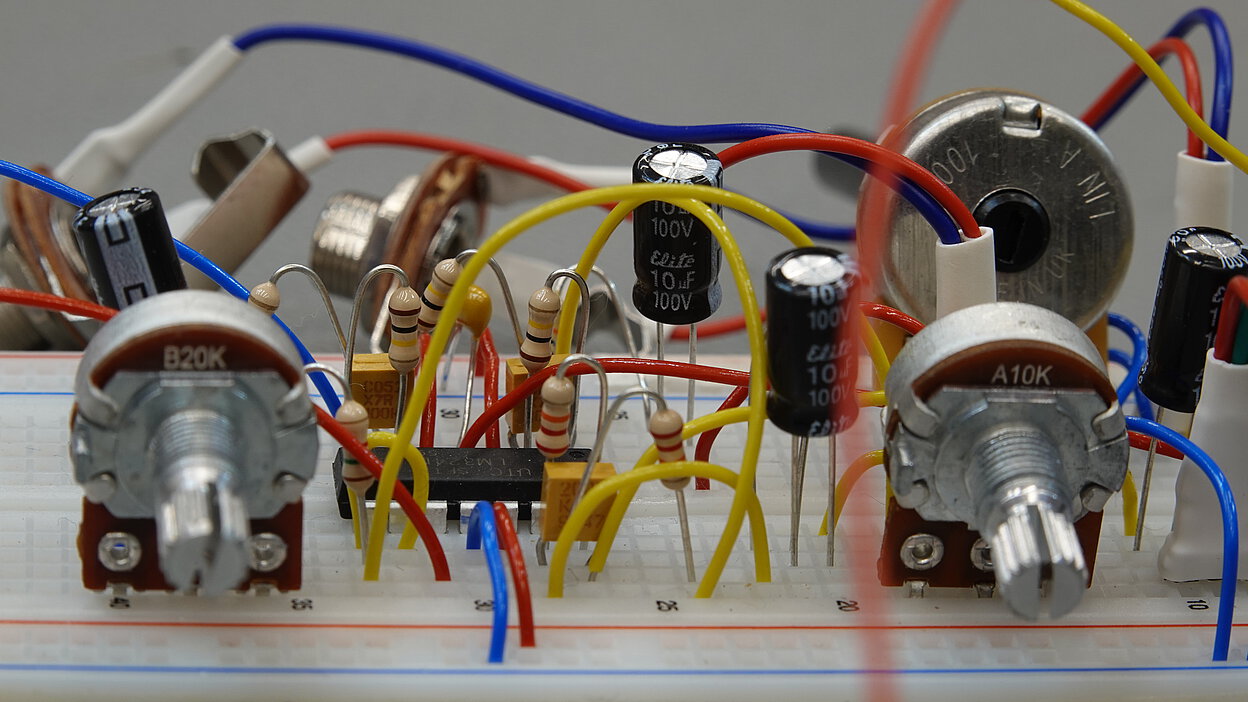
"Circuitry-Based Sound" is a transdisciplinary music seminar focused on DIY electronics and group performance. The course explores DIY culture, breadboarding, circuit hacking, music interaction, and experimental sound creation. Participants will gain insights into the artistic and practical possibilities of self-built electronic instruments while addressing critical issues like planned obsolescence and mass production. Students develop their own custom sound systems and interfaces, culminating in a collaborative live performance.
Course Content
- Explore DIY culture, breadboarding, and circuit hacking for sound creation
- Learn fundamentals of electronics, Boolean logic, and digital circuits
- Design and build self-made electronic instruments for experimental sound synthesis
- Engage in group improvisations and collaborative ensemble performance
- Prepare for a public concert presentation featuring self-built instruments
Prerequisites
- Basic understanding of sound and electronics recommended but not mandatory
- Suggested resources Circuitry-Based Sound (accompanying online documentation), Hardware Hacking by Nicolas Collins (practical introduction to making electronic circuits)
Learning Objectives
- Gain practical skills in experimental sound creation and music interaction
- Understand and implement fundamentals of electronics and prototyping
- Explore collaborative live performance techniques and improvisation
Credits
- Leistungsnachweis Medienkunst (graded Course Credit)
Methods
- Weekly workshops combining theoretical lessons and practical exercises
- Listening sessions and case studies of electronic music and sound art
- Regular jam sessions and collaborative improvisations
Assessment tasks
- Create an oscillator circuit on a breadboard, test various interaction possibilities and document its functionality
- Collaboratively rehearse and structure a live performance using custom-built instruments
- Perform in a public concert showcasing self-built instruments and group improvisation
Workload
- In-class time approximately 65 hours over 14 weeks
- Independent work approximately 15 hours for concert preparation and rehearsals
- Total approximately 80 hours
Recommended literature
- Anderton, Craig. Electronic Projects for Musicians. Amsco, 1980.
- Barlow, Clarence. On Musiquantics. Bereich Musikinformatik, Johannes Gutenberg-Universität Mainz, 2012.
- Brindley, Keith. Starting Electronics. Newnes, 2011.
- Collins, Nicolas. Handmade Electronic Music: The Art of Hardware Hacking. 2nd ed., Routledge, 2009.
- Horowitz, Paul, and Winfield Hill. The Art of Electronics. 3rd ed., Cambridge University Press, 2015.
- Lancaster, Don. Das CMOS-Kochbuch. IWT-Verlag, 1980.
- Landy, Leigh, and John Richards. The Music of Sounds and the Music of Things: Sonic Creativity within Sampling and DIY Cultures. Routledge, 2024.
- Maxfield, Clive. Bebop to the Boolean Boogie: An Unconventional Guide to Electronics. 3rd ed., Newnes, 2009.
- Roads, Curtis. The Computer Music Tutorial. MIT Press, 1996.
- Self, Douglas. Small Signal Audio Design. 3rd ed., Focal Press, 2020.