Designing Voltage Controlled Music Systems
Compact Seminar
-

- Language of instruction
- English
- Semester offered
- WS 2021/22
- Schedule
Compact intensive
- Date(s) & Time
- Three days, full-day
- Contact hours per semester
- 22
- Location
- Room 351
- Instructor(s)
- Lorenz Schwarz
This compact seminar surveys established techniques for analog audio synthesis. Participants will explore the electrical analogs of musical events, the parameters of electronic sound, and the use of control voltages (e.g., envelopes, gate, and trigger signals). Key topics include the theory of basic signal processing, filtering concepts, and modulation techniques.
Particular emphasis will be placed on subtractive sound synthesis, waveshaping, amplitude modulation (AM), frequency modulation (FM), and ring modulation. The seminar also integrates theoretical aspects and performance practices, focusing on their implementation using modular analog synthesizers. Students will configure patches to program electronic sounds and manipulate musical variables to achieve desired sonic and aesthetic outcomes. The aim is to build up a basic understanding of modular synthesizer, how they work and how to use them.
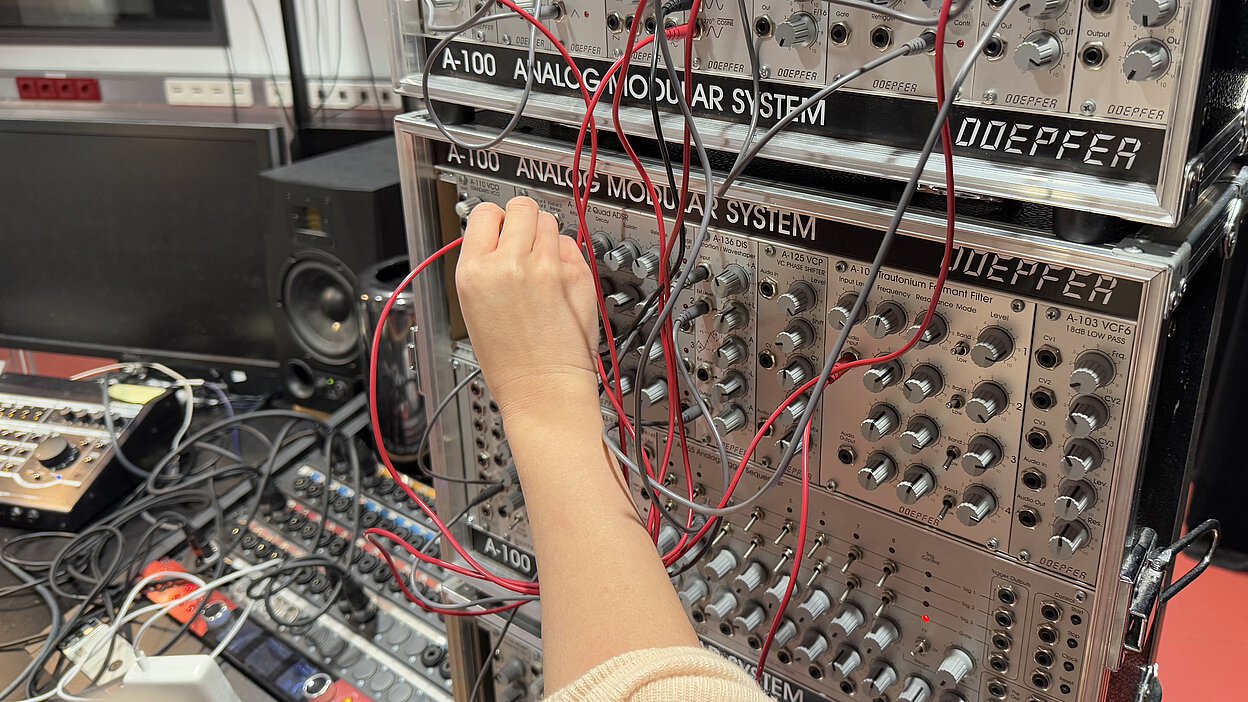
The course revolves around the MK Sound Eurorack modular system and includes both theoretical and practical components. Participant numbers are limited, and registration operates on a first-come, first-serve basis.
Course Content
The course combines theoretical lectures and hands-on practical exercises to provide students with both foundational knowledge and applied skills. The structure includes:
- History and foundations of electronic music (key developments, theoretical principles, significant works)
- Fundamentals of electronics (basic electrical principles and components for audio synthesis)
- Hands-on training with modular synthesizers (patching, signal routing, subtractive synthesis)
- Voltage control and sound design (oscillators, filters, amplifiers)
- Modulation techniques (AM, FM, ring modulation, waveshaping)
- Timing and sequencing (sequencers, gate signals, rhythmic modulation)
Prerequisites
- Basic knowledge of sound synthesis and synthesizers required
- Suggested resources 120 Years Of Electronic Music (The history of electronic musical instruments from 1800 to 2019), The Principles of Voltage Control (Technical details of the Doepfer Eurorack modular system)
Learning Objectives
- Understand the fundamentals of analog synthesis and modular systems
- Apply concepts of subtractive synthesis, waveshaping, and common modulation techniques
- Develop basic skills in programming and performing with modular synthesizers
Credits
- Grundlagennachweis Sound / Raumklang (Foundation Certificate)
- Workshop-Nachweis Medienkunst (Workshop Credit)
Methods
- Lectures on the history and development of electronic music
- Practical demonstrations of modular synthesis techniques
- Using oscilloscopes to visualize analog signals
- Hands-on exercises using the MK Sound Eurorack modular system
- Collaborative discussions on aesthetic and performance practices
Assessment tasks
- Configure and document a modular patch demonstrating subtractive synthesis or modulation techniques
- Create and present a short live performance using self-programmed modular patches
Recommended literature
- Roads, Curtis. Composing Electronic Music: A New Aesthetic. Oxford University Press, 2015.
- Strange, Allen. Electronic Music: Systems, Techniques, and Controls. Responsive Ecologies Lab / Toronto Metropolitan University, 2022.