Introduction to Sound Technology and HfG Sound Studios
Compact Seminar
-

- Language of instruction
- English
- Semester offered
- SS 2025
- Schedule
One-week workshop
- Date(s) & Time
- One week, full-day
- Contact hours per semester
- 35
- Location
- Room 351, 354, 355
- Instructor(s)
- Lorenz Schwarz
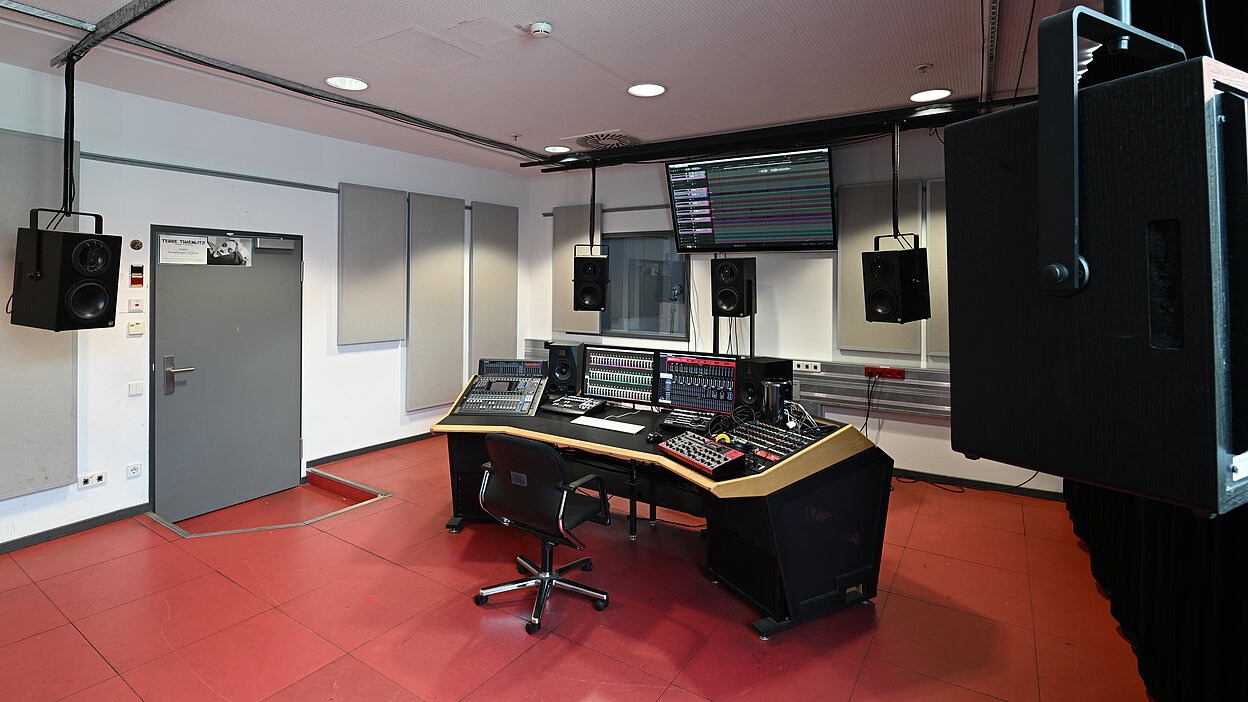
This compact seminar provides foundational knowledge of sound technology and studio operation essential for working in the HfG's production studios. The course covers the physics of sound, acoustics, and sound perception, as well as the principles of acoustic transducers and sound generators. Participants will learn both the theory and practical aspects of analog and digital signal processing, including the operation of mixing desks, sequencers, audio interfaces, amplifiers, and connection technologies.
Students will gain hands-on experience in studio setup and maintenance, covering topics such as close miking of instruments, speech recording, DAWs, monitor loudspeakers, and talkback systems. Software such as Cubase, Adobe Audition, Reaper/Fairlight, Ableton Live, Max/MSP, and Audition will be introduced based on the participants’ needs and production workflows.
Upon successful completion, students receive a basic certificate (Grundlagennachweis) allowing them to use the HfG sound studios. As a practical requirement, participants will create a sound piece in the studios, demonstrating their understanding of the equipment and techniques covered in the course.
Course Content
- Acoustic control and room treatment in studio environments
- Recording booth setup and isolated recording practices
- Sound studio basics including components, workflows, and design principles
- Control room setup, operation, monitoring, and signal routing
- Monitor loudspeakers including types, placement, and calibration
- Talkback systems for recording session communication
- Mixing desks (analog and digital mixers, signal flow, routing)
- Cabling, connectors, and audio signal transmission
- Microphones (types, placement techniques, applications)
- Close miking techniques for instruments
- Speech recording setup and execution
- Digital audio workstations (Cubase, Adobe Audition, Reaper/Fairlight, Ableton Live)
Prerequisites
- No prior knowledge required; open to students from all departments
- Suggested resources Sengpiel Audio (audio tutorials and documentation on sound recording and studio technology)
- Suggested software REAPER -Digital Audio Workstation (digital audio workstation), Audacity- audio editing and recording app (audio editing and recording)
Learning Objectives
- Understand the principles of acoustics, sound perception, and sound generation
- Operate studio equipment including mixing desks, audio interfaces, and amplifiers
- Gain proficiency in digital audio workstations and recording workflows
- Learn techniques for close miking, speech recording, and studio maintenance
- Create a sound piece utilizing the equipment and techniques learned
Credits
- Grundlagennachweis Sound / Raumklang (Foundation Certificate)
- Workshop-Nachweis Medienkunst (Workshop Credit)
Methods
- Lectures on the theoretical aspects of sound and studio technology
- Practical demonstrations and hands-on exercises in the sound studios
- Individual and group tasks to reinforce technical and creative skills
Assessment tasks
- Create and submit a sound piece in the HfG studios demonstrating proficiency in equipment operation and course concepts
Workload
- In-class time approximately 35 hours (one week workshop, 7 hours daily)
- Independent work approximately 10–15 hours for creating the sound piece and assignments
- Total approximately 45–50 hours
Recommended literature
- Ballou, Glen M., editor. Handbook for Sound Engineers. 4th ed., Focal Press, 2008.
- Görne, Thomas. Tontechnik. 4th ed., Hanser, 2014.
- Weinzierl, Stefan, editor. Handbuch der Audiotechnik. Springer, 2008.