New Interfaces for Music
Practical Lab
-

- Language of instruction
- English
- Semester offered
- SS 2021
- Schedule
One week
- Date(s) & Time
- Full-day
- Contact hours per semester
- 25
- Location
- as announced
- Instructor(s)
-
Lorenz
Schwarz
Dr. Paul Modler
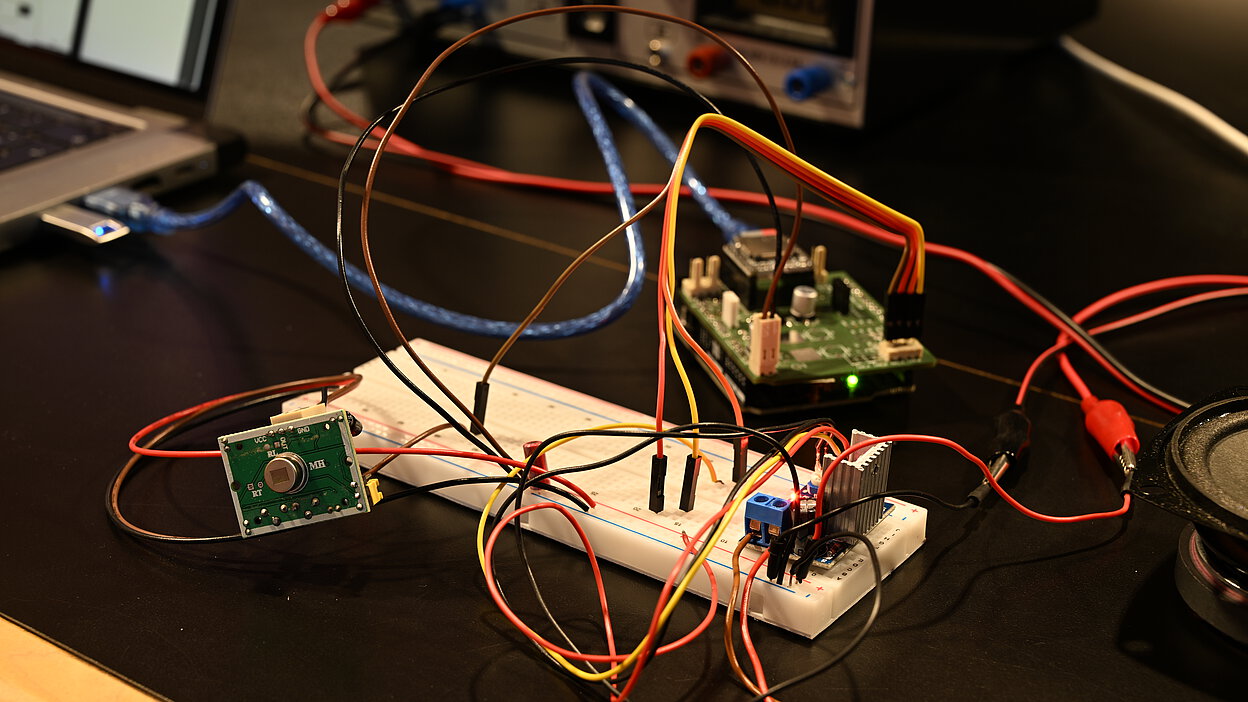
This workshop delves into the design and creation of new interfaces for musical expression, with a focus on integrating microcontrollers such as Arduino, Raspberry Pi, and Espressif Systems. Participants explore the use of sensors including touch, motion, and environmental sensors to create innovative tools for sound interaction. The course combines theoretical insights into human-machine interaction and multimodal performance with hands-on experimentation. Participants design sensor-based interfaces and embedded instruments to develop new approaches to musical expression.
The workshop culminates in a group presentation showcasing interactive installations and performances that highlight the creative possibilities of combining technology and musical expression.
Prerequisites
- No prior knowledge required; open to students from all disciplines
- Suggested resources NIME Conference Archive (proceedings and documentation of new interfaces for musical expression)
Learning Objectives
- Develop skills in designing sensor-based musical interfaces
- Explore alternative forms of musical expression through multimodal interaction
- Understand principles of human-machine interaction in musical contexts
- Gain proficiency with microcontrollers and sensor integration for sound
Credits
- Leistungsnachweis Medienkunst (graded Course Credit)
- Workshop-Nachweis Medienkunst (Workshop Credit)
Methods
- Theoretical discussions on human-machine interaction and musical interface design
- Hands-on experimentation with wearable devices, sensors, and embedded instruments
- Final presentation of installations and performances created during the course
Assessment tasks
- Experiment with wearable or sensing-based interfaces and document findings
- Design and create an interactive sound installation or performance
- Present the developed work in a public group presentation
Workload
- In-class time approximately 35 hours (full-day sessions over five days)
- Independent work approximately 10–15 hours for experimenting, documenting, and preparing the final presentation
- Total approximately 45–50 hours
Recommended literature
- Cook, Perry R. “Principles for Designing Computer Music Controllers.” Proceedings of the International Conference on New Interfaces for Musical Expression, Seattle, WA, 1–2 Apr. 2001, pp. 3–6. https://doi.org/10.5281/zenodo.1176358.
- Edstrom, Brent. Arduino for Musicians: A Complete Guide to Arduino and Teensy Microcontrollers. Oxford University Press, 2016.
- Freed, Adrian. “The Fingerphone: A Case Study of Sustainable Instrument Redesign.” In Current Research in Systematic Musicology, 2017, pp. 391–404. https://doi.org/10.1007/978-3-319-47214-0_25.
- Miranda, Eduardo Reck, Marcelo M. Wanderley, et al. New Digital Musical Instruments: Control and Interaction beyond the Keyboard. A-R Editions, 2006.
- Wessel, David, Matthew Wright, and John Schott. “Intimate Musical Control of Computers with a Variety of Controllers and Gesture Mapping Metaphors.” Proceedings of the International Conference on New Interfaces for Musical Expression, Dublin, Ireland, 2002, pp. 192–194. https://doi.org/10.5281/zenodo.1176472.
- Wright, Matthew, and Adrian Freed. “Open SoundControl: A New Protocol for Communicating with Sound Synthesizers.” Proceedings of the International Computer Music Conference, International Computer Music Association, Thessaloniki, Greece, 1997, pp. 101–104.