The Concert of Daily Objects
Seminar
-

- Language of instruction
- English
- Semester offered
- WS 2024/25
- Date(s) & Time
- Eight sessions throughout semester
- Contact hours per semester
- 25
- Location
- Glass Cube, Room 207
- Instructor(s)
-
Lorenz
Schwarz
Wieki Somers
Stefan Legner - Invited guest(s)
-
Klangphonics
Sebastian Viering
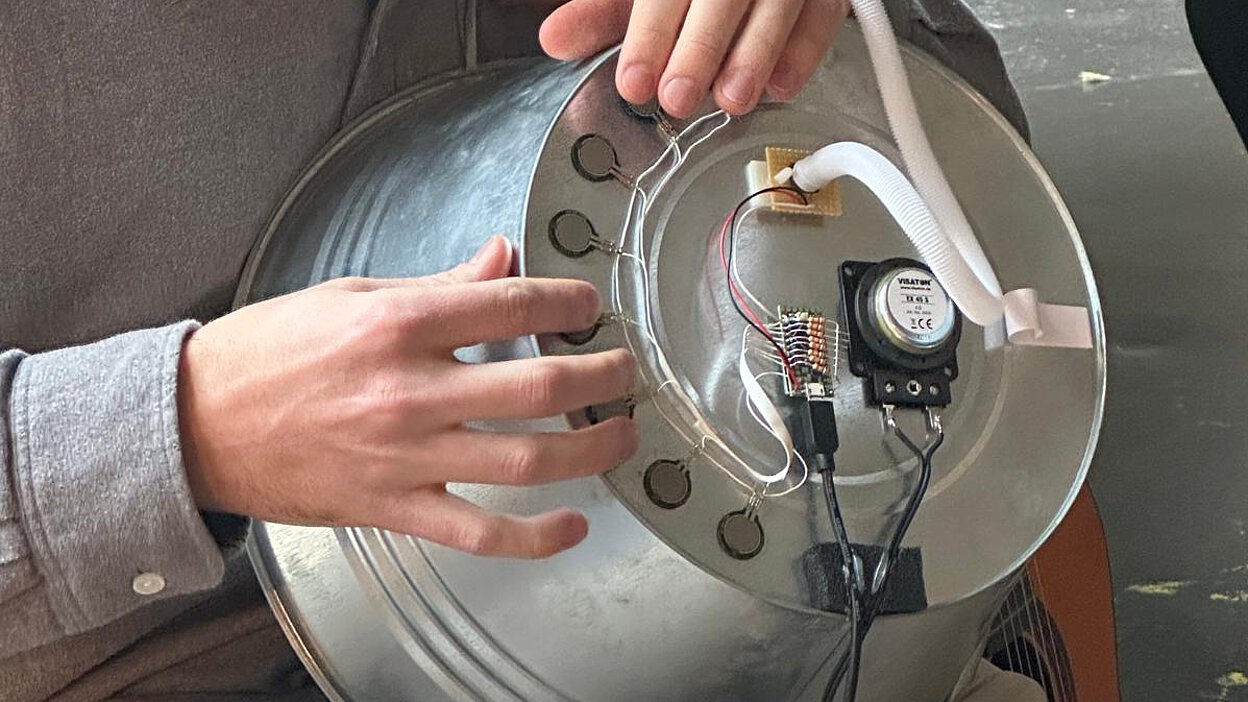
This interdisciplinary workshop invites participants to explore the sounds of everyday objects and transform them into musical instruments or sound installations. Combining perspectives from product design and media art, the course highlights the often-overlooked role of sound in the design process. Participants will investigate the sonic potential of various materials, collect and transform everyday items, and create musical compositions.
The workshop includes guest sessions with Klangphonics, a Berlin-based group blending acoustic and electronic elements, and industrial designer Sebastian Viering, who bridges electronic and acoustic music-making. A visit to the German Music Automaton Museum in Bruchsal will provide additional inspiration, showcasing the historical interplay between design and sound.
Hands-on sessions will focus on experimenting with objects, creating samples, and crafting unique musical performances. Students will have access to workshops for metal, wood, and plastics, as well as sound facilities, enabling them to bring their ideas to life. The workshop culminates in a public performance or presentation of the final projects.
Prerequisites
- No prior knowledge required; open to students from all departments
- Suggested resource Introduction to Klangphonics’ works
Learning Objectives
- Explore the sonic potential of everyday objects and materials.
- Gain inspiration from historical and contemporary examples of experimental sound and music.
- Present a final project in the form of a performance or installation.
Credits
- Workshop-Nachweis Medienkunst (Workshop Credit)
Methods
- Guest workshops and lectures by Klangphonics and Sebastian Viering.
- Group discussions and brainstorming sessions.
- Hands-on experimentation with everyday objects and materials.
- Visits to the German Museum of Music Automatons for historical context.
Assessment tasks
- Collect and experiment with objects to explore their sonic potential
- Collaborate on the design and creation of a musical instrument or sound installation
- Present the final project in a public performance or exhibition
Workload
- Eight full-day workshops and sessions, approximately 40 hours
- Independent work (collecting, experimenting, development), approximately 15–20 hours
- Total approximately 55–60 hours
Recommended literature
- Davies, Hugh. Sounds Heard: A Potpourri of Environmental Projects and Documentation, Projects with Children, Simple Musical Instruments, Sound Installations, Verbal Scores, and Historical Perspectives. Soundworld Publishers, 2002.